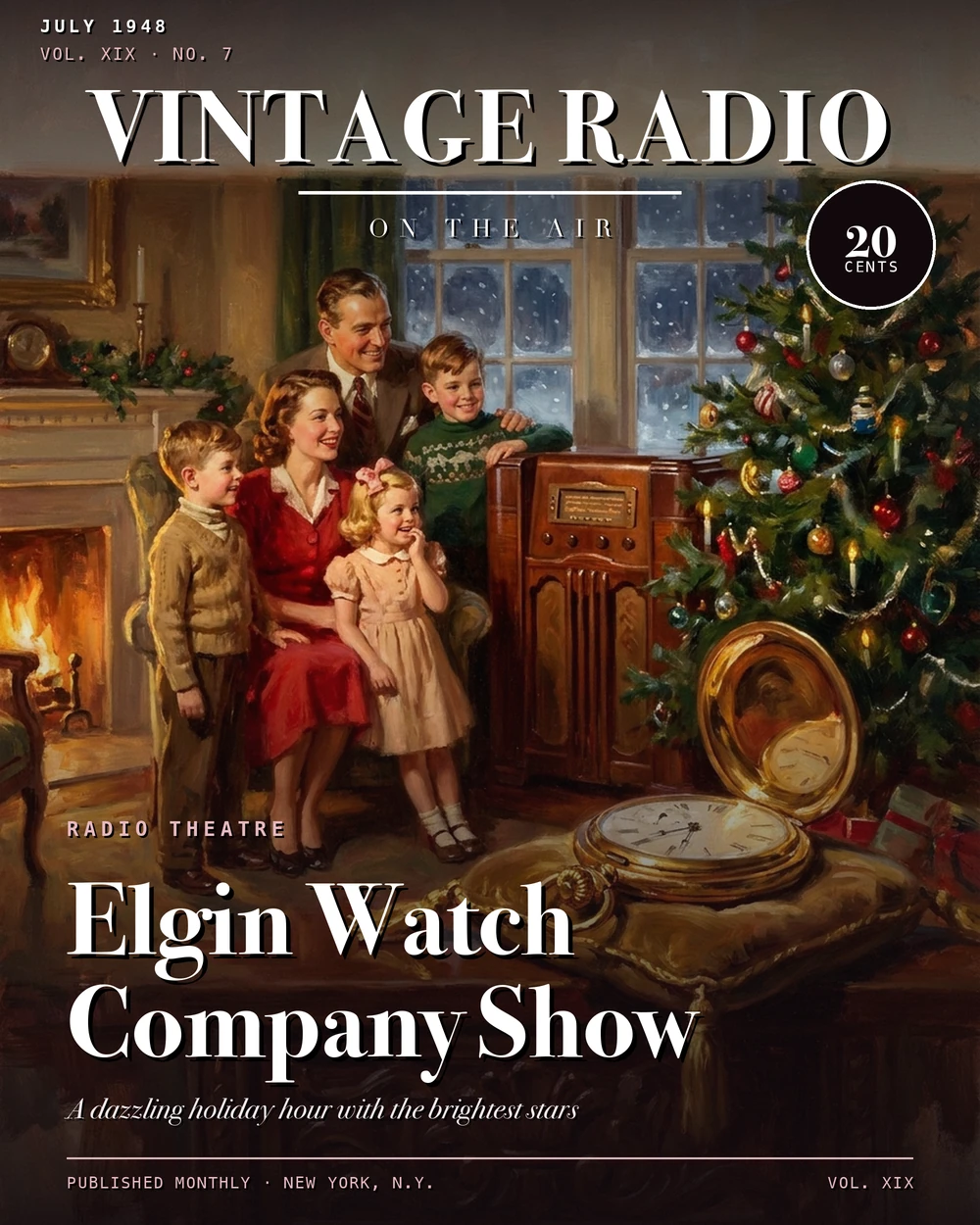
Elgin Watch Company Show
Two Hours of Stars
The Elgin Watch Company Show wasn't really a weekly program with a regular time slot and a steady cast. It was something more unusual: a series of all-star holiday spectaculars, staged twice a year on Thanksgiving and Christmas, designed from the beginning to entertain U.S. servicemen and women overseas during World War II. The shows launched in 1942 and ran through 1948, producing 14 programs in all. Each one ran a full two hours — an enormous commitment of airtime and money — and each one was transmitted not only over CBS but by shortwave and Armed Forces Radio to military installations around the world. The informal name the shows carried after 1944 said it plainly: Two Hours of Stars.
The whole enterprise was the brainchild of J. Walter Thompson, the advertising agency representing the Elgin National Watch Company. Thompson had the clout to assemble talent from across the radio industry, and the first 1942 broadcast demonstrated exactly how far that reach extended. NBC stars Edgar Bergen and Charlie McCarthy, Red Skelton, and Ozzie and Harriet Nelson all appeared — on a CBS broadcast. That kind of cross-network casting was rare, and it set the tone for everything that followed. Elgin wasn't buying a conventional radio program. It was buying an event.
The Man Behind Every Show
Don Ameche served as master of ceremonies for all 14 programs in the run. That kind of consistency across seven years of holiday broadcasting was unusual, and it gave the shows a stable center even as the guest rosters rotated through what amounted to a catalogue of mid-1940s American stardom. Ameche was a movie star with a natural ease on radio, and his role held the sprawling two-hour format together across performances, comedy sketches, and whatever promotional content Elgin wove into the mix.
The blend of entertainment and advertising was built into the format from the start. These were sponsored programs, and Elgin's products were part of the broadcast. The Elgin National Watch Company was, by its own claim, the largest watch manufacturer in America at the time — though during World War II all civilian production had stopped and the company was manufacturing military watches, chronometers, and precision instruments. Sponsoring a program explicitly designed to reach servicemen and women overseas had an obvious logic to it, and the Armed Forces Radio distribution meant the shows went wherever American military personnel were stationed.
The Rosters
The guest lists for the surviving Christmas broadcasts give a clear picture of what Elgin and J. Walter Thompson were assembling. The 3rd Annual Christmas Show, on December 25, 1944, brought together Ginny Simms, Jack Benny, George Burns, Gracie Allen, Carmen Miranda, the Les Paul Trio, Bob Hope, and Bing Crosby, with Louis Silvers and His Orchestra providing the musical backbone. That's not a lineup you could put together for an ordinary broadcast — it represented a significant portion of the biggest names in American entertainment at the time, sharing a single two-hour program.
The 4th Annual Christmas Show, December 25, 1945, kept Benny and Hope and added Red Skelton, pianist Artur Rubinstein, and General Omar Bradley. Rubinstein alongside Bradley alongside Bob Hope is a combination that captures something specific about what these wartime and immediate postwar specials were trying to be: not just entertainment, but a broad cultural gesture. The 7th Annual Christmas Show, December 25, 1948, featured Al Jolson, operatic tenor Lauritz Melchior, Danny Thomas, Jo Stafford, Edgar Bergen, Cass Daley, and Ozzie Nelson and Harriet Hilliard.
The Thanksgiving shows followed the same format and drew comparable talent. A Variety review from December 3, 1947 described the Elgin Thanksgiving show as an increasingly "institutional" fixture on CBS, praising individual performances across the full two-hour broadcast. That word — institutional — is telling. By 1947, these shows had been running long enough that the radio audience could anticipate them the way you'd anticipate a holiday tradition. The November 25, 1948 Thanksgiving show featured early appearances by Dean Martin and Jerry Lewis, with Martin introduced as a "promising newcomer."
What the Shows Cost
By 1948, each broadcast was estimated to cost around $100,000. Of that, roughly $60,000 went to talent and $26,000 to network time. Those are substantial figures for a radio program at any point in the medium's history, and they reflect what it actually took to book rosters of that caliber twice a year. According to a June 1949 Variety report, Elgin cancelled the holiday shows that year citing poor business conditions and the high cost of production. The 7th Annual Christmas Show on December 25, 1948 turned out to be the last one.
The cancellation wasn't a ratings failure — Variety had been complimentary as recently as 1947 — but rather a business decision made under financial pressure. The Elgin National Watch Company itself would continue operating for another two decades before halting operations entirely in 1968, after a period of diversification into decorator clocks, transistor radios, and wedding rings. The holiday broadcasts were only one piece of Elgin's wartime and postwar radio presence; the company also sponsored the CBS war drama The Man Behind the Gun beginning in 1943, suggesting a broader investment in radio as an advertising medium during those years.
What Survives
Twelve episodes are known to exist. The surviving Christmas broadcasts include the 3rd Annual (December 25, 1944), the 4th Annual (December 25, 1945, preserved in three parts), and the 7th Annual (December 25, 1948, with parts 1, 3, and 4 in the catalog). A Thanksgiving show from 1947 also survives, represented by two catalog entries.
The gaps in the surviving record are worth noting honestly. The shows began in 1942, and the earliest surviving Christmas broadcast is from 1944 — the 3rd Annual. What happened to the 1942 and 1943 Christmas recordings, and to most of the Thanksgiving programs, isn't documented in the available record. What does survive, though, covers the peak years of the series and preserves some of the most densely star-studded variety programming that American commercial radio produced during the 1940s. The combination of consistent hosting, top-tier talent, wartime purpose, and the unusual two-hour format made the Elgin holiday shows something distinct from ordinary sponsored radio, and the twelve surviving episodes hold up as a document of what the medium could do when a sponsor was willing to spend to find out.